

AlloClae vs. Traditional Fat Transfer: What’s the Difference?
People who end up comparing these two usually started somewhere else in their research—maybe looking into BBL options, maybe trying to understand why AlloClae keeps coming up as an alternative—and landed here because the surface-level explanation wasn’t enough. Two treatments. Same basic idea. Completely different reality. The “both use fat” description is technically accurate and practically useless. What actually matters is what the procedure asks of you, what your body needs to qualify, and what you can realistically expect to get out of it.
Start With What Fat Transfer Actually Requires
The Brazilian Butt Lift—the most common fat transfer procedure for body contouring—involves two things happening in the same surgery. First, liposuction. Fat gets harvested from donor areas on your body, usually the abdomen, flanks, or thighs. Then that fat gets processed and reinjected into the buttocks. It’s your own tissue going back in, which is why biocompatibility isn’t a concern and why, when it works well, it can produce significant and lasting results.
What it asks of you is substantial though. You need enough fat in the donor areas to make harvesting worthwhile—lean patients simply don’t qualify. You need to be a candidate for surgery and anesthesia. And you need to commit to a recovery that involves weeks of restricted sitting, sleeping positions that most people find genuinely uncomfortable, and time off from normal life. Most patients take a week or two away from work. Returning to exercise takes longer. Avoiding direct pressure on the treated area for the first several weeks is non-negotiable—the transferred fat needs blood supply to survive, and compression works against that.
A portion of the transferred fat doesn’t survive regardless. How much gets reabsorbed varies by patient and by technique. Some providers report retention rates around 60 to 80 percent. Others see less. The final result isn’t fully apparent until the reabsorption phase completes, which takes months.
For patients who qualify and go in with realistic expectations, fat transfer can be worth every bit of that. For patients who don’t qualify—or who don’t want surgery—none of that matters because it’s not an option either way. AlloClae vs. BBL is one of the most common questions our clients have.
AlloClae Doesn’t Start With Liposuction
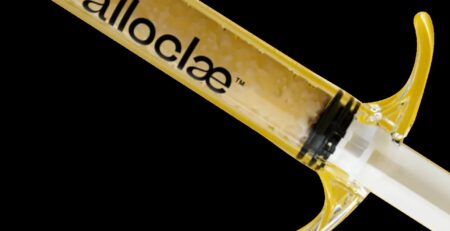
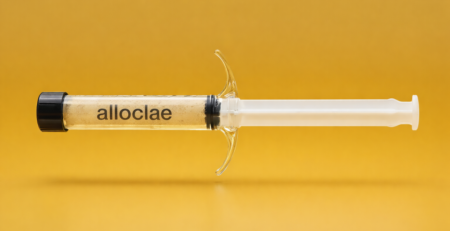
That’s the fundamental difference that changes everything downstream. AlloClae is a structural adipose filler made from donor fat—not the patient’s own fat, donor tissue that’s been processed to remove what the body might reject and preserve what actually does the work. The extracellular matrix. Collagen. Elastin. Growth factors. The structural framework that your cells can move into and build around once it’s placed.
It arrives prepackaged. The injector loads it into a syringe. The procedure happens in the office. No surgical facility, no harvesting, no recovery measured in weeks. Most patients are back to normal activity within a few days, with the main restriction being avoiding direct pressure on the treated area and skipping intense exercise for two to three weeks while the matrix begins integrating.

The ceiling on volume is lower. That’s real and worth saying directly. A single AlloClae session won’t replicate the volume that fat transfer achieves at its upper end. For patients whose goals sit at the dramatic end of augmentation, that limitation matters. For patients who want to improve proportion, correct hip dips, add a meaningful amount of projection or fullness, and do it without surgery—AlloClae frequently gets them exactly where they wanted to go.
Hip dip correction specifically is one of the areas where AlloClae has changed what’s possible without surgery. The indentation that forms along the lateral hip is structural—it doesn’t respond to any amount of exercise or weight gain—and placing the right volume of AlloClae into that area with accurate technique restores a more natural curve from hip to thigh. Patients who’ve been bothered by that since their teens sometimes describe the result as finally looking like the version of themselves they always wanted. That’s not a small thing.
AlloClae Results And How Long They Hold
Fat transfer results, when the retained fat survives well, can be durable. The tissue behaves like native fat because it came from the patient’s body. Significant weight fluctuation can affect it over time, but patients who maintain their weight often hold good results for years.
AlloClae results run 12 to 18 months as a general benchmark, with variation depending on the individual and the area treated. The structural matrix integrates with surrounding tissue rather than degrading on a fixed schedule the way synthetic fillers do, which is part of why longevity tends to be better than standard HA filler at comparable volumes. Patients who’ve done multiple rounds often find the second treatment holds better than the first—the tissue has already been through the integration process once.
Neither is permanent. Both require maintenance thinking at some point. The difference is that one requires surgery to get there and the other doesn’t.
Some Patients Use Both
Worth mentioning because it doesn’t come up in most comparisons. AlloClae isn’t always competing with fat transfer—sometimes it’s working alongside results from fat transfer. Patients who’ve had a BBL and want to address areas that absorbed unevenly, or touch up results that have softened over time, sometimes find AlloClae a practical option for those specific areas. The two approaches aren’t mutually exclusive.
Some patients also use AlloClae while they’re deciding whether surgery is right for them. It’s not a permanent decision—results fade—and it gives patients a chance to live with a contoured result before committing to something surgical.
The most useful conversation about these two options happens in person, with someone looking at your actual anatomy and hearing what you’re actually trying to achieve. At Virtual Skin Spa in Jericho, Theresa Pinson works with AlloClae for non-surgical body contouring on Long Island and will give you a direct read on whether it fits your goals—or whether the surgical conversation is the one worth having instead.
Book a consultation here or call (917) 331-6191.




Leave a Reply
You must be logged in to post a comment.